The best courtyard I have found in an unfamiliar city was behind a door that was not quite shut. Heavy green paint, a hand's width of dark, and a strip of sunlight on the pavement that did not match the angle of the street. I stood there for a minute and listened. Water, somewhere. A radio. Then I pushed the door with two fingers, stepped inside, and spent eight quiet minutes in a small tiled yard with a lemon tree and a bicycle. Nobody minded.
That outcome depended on a dozen small judgements made before I crossed the threshold. Courtyards are not hidden because they are secret. They are hidden because most people walk past them at speed. Slow down, learn what a doorway is telling you, and a city opens up at ground level.
Read the street at walking pace
Most people hunt for courtyards on a map, which is the one place they rarely appear. Private yards have no names and no pins. The ones that do carry a label worth searching for — pátio in Lisbon, cortile in Rome, Hof in Vienna, patio in Seville — but the better finds usually come from reading the street itself.
Walk the same block twice: once at eye level, once looking up. Cornices, gutters and rooflines betray internal voids. A building whose roof steps down mid-facade almost always wraps around something open. So does a second row of windows set deeper than the street frontage.
Other signals are easier to miss than to find:
- A gap in the facade wider than a doorway but with no shop sign above it.
- An arch you can see through, even slightly.
- Drainpipes that turn inward instead of running straight down to the pavement.
- Planters, a bench, or a folded chair visible in a passage.
- Delivery crates stacked somewhere cool and shaded.
- The sound of water, a radio, or a broom from nowhere in particular.
- House numbers that skip a digit.
Learn what a doorway is saying
Doors carry a hierarchy of openness, and you can read it from the pavement in a few seconds. A gate hooked fully open, with chairs in the passage and someone reading a newspaper, is usually a space where quiet visitors are tolerated. A gate standing open onto an empty passage is more ambiguous — worth a slow approach, not a confident stride.
Look for the pedestrian door cut into a larger carriage gate. Check the ground for wear; hinges tell you which way it swings and whether it swings often. A panel of buzzers with surnames, rows of letterboxes, brass nameplates polished by hand: that is a residential building, and the courtyard is somebody's hallway. A printed sign, however small and however little of the language you read, is an answer.
Do not overlook the semi-public courtyards. Universities, public libraries, hospitals, museums, town halls, churches and their cloisters often have courtyards that are open to anyone during opening hours. They are less romantic than a hidden residential yard, but they are legitimate, often beautiful, and usually empty on weekday mornings. Look for an information desk, students, or a porter's lodge and you will know where you stand.
The thirty-second welcome test
Before you step through, run through a short set of questions. You do not need a perfect score; you need to notice when several answers go the wrong way.
- Is the gate open without me having to touch it?
- Can I see the ground floor clearly, and a straightforward way back out?
- Are there signs of public life — bins, bicycles, a café's crates, a noticeboard?
- Is there anyone I could greet, and whose reaction I could read?
- Is this a passage people cross, or a place where people live?
- Would I be standing within arm's reach of anyone's window or washing line?
- Would I be comfortable if a resident filmed me doing exactly what I am about to do?
If two or three of those make you hesitate, take the photograph from the street and move on. There are more courtyards than there are days. Nothing is lost by leaving one alone.
Enter without becoming a problem
Greet whoever is there, even if the yard looks empty. Windows have ears. A quiet buongiorno, bom dia or bonjour costs nothing and buys a great deal of tolerance.
Do not prop the gate, and do not close it if it was open. Stay near the middle of the yard rather than crossing to anyone's front door. The courtyard is one thing; the stairwell is another, and the landing is a third. Keep off the stairs. Do not move furniture, sit on steps, or shift a bicycle to improve your composition. Keep phone calls for the street. Ten minutes is a long visit — five is usually enough.
Carry your camera discreetly, without a tripod and without a bag that looks professional. If a door opens, smile, nod, and be ready to leave without being asked. And if someone does ask you to go, go. Immediately, politely, without debate. That person's goodwill is worth more than any photograph, and it keeps the door open for the next curious visitor.
Photographing a small, difficult space
Courtyards are light wells, which means extreme contrast and a sky that wants to blow out. Everything below is about managing that.
Light
Expose for the walls, not the sky. Tap to meter on the brightest wall you care about and let the shadows go dark; a courtyard with deep shade reads as a courtyard, while a flat, lifted image reads as a car park. Mid-morning and late afternoon give you angled light on one wall and shade on another, which is what makes these spaces look three-dimensional. Overcast weather is a gift, not a disappointment. Turn the flash off and leave HDR on.
Frame
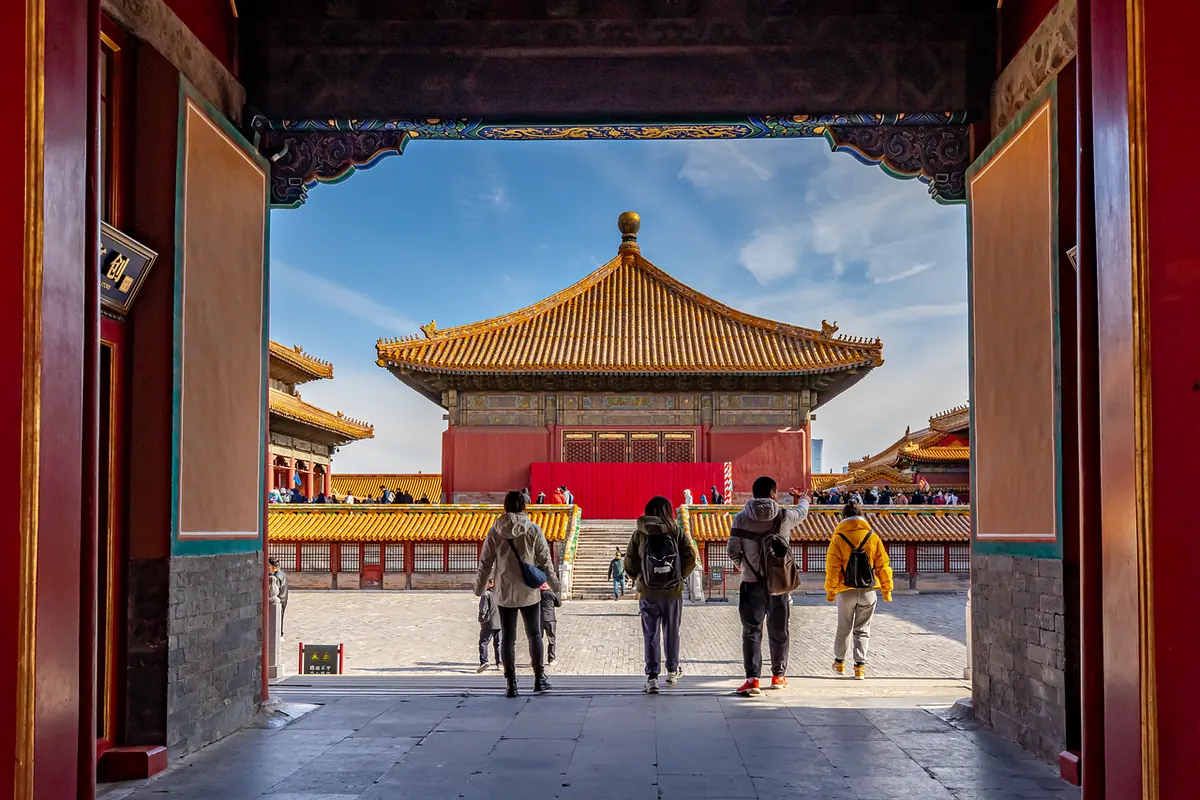
Stand in the passage and use the door jambs or the arch as a frame. Keep vertical lines vertical — tilt the phone rather than leaning back, or the walls will splay. Resist the wide shot that includes everything. A courtyard photograph is usually about one corner: a chair, a watering can, a bicycle against tiles, a number painted on a wall. Include one human trace and the space stops being architecture and starts being a place.
Patience and people
Wait for a shutter to open, a cat to cross, a cloth to be shaken out of a window. Do not stage anything and do not ask anyone to move, repeat a gesture, or look up. If a person is going to be the centre of your frame, ask first, and accept a no without visible disappointment. Between the portraits, photograph textures: tiles, drainpipes, doorbells, a broom leaning where it was left. Ten good frames beat a hundred hurried ones.
When someone asks what you are doing
Answer honestly and briefly: you are photographing courtyards, the door was open, you will leave now. Offer to show the picture, and offer to delete it if that helps. Do not argue, do not explain the artistic merits of the shot, and do not negotiate. Learning the local word for courtyard before you travel — cortile, pátio, cour, Hof, avlu — makes that conversation much shorter and much friendlier.
Pack light, plan a loop, and keep notes
You need very little: a phone or a small camera, one lens, comfortable shoes that do not announce you, and a notebook or a notes app. Plan a route by block rather than by address — pick six or eight promising blocks in one neighbourhood and walk them slowly, twice. Weekday mornings are best, when doors are open for deliveries and post; Sunday is mostly locked. Write down what you found: the street, what the gate looked like, the time of day, whether you were welcomed. Then go back at a different hour and see how the light changes.
The courtyard you remember will not be the grandest one. It will be the one you had to slow down to find, and the one you left exactly as you found it.
Photo: 素君 / Pixabay