A wall gets painted on a Tuesday night. By Wednesday morning the whole street has an opinion. One neighbour calls it graffiti, another calls it street art, the building owner calls it damage, and the local paper calls it "street art" because that sells better. Four words for one wall, and none of them mean quite the same thing.
They are not synonyms, and the gap between them is wider than most people assume. It isn't a matter of quality, and it isn't a matter of taste. It comes down to form, permission, intent and — more than anywhere else — the ground the paint sits on. Getting the vocabulary right changes how you look at a wall, and it changes what you can reasonably do about it.
Where the two words come from
Graffiti is the older word. It comes from the Italian graffiare, to scratch, and it was used for the marks people left on walls long before anyone was writing a name in spray paint — the scratched slogans of Pompeii are graffiti in the original sense. The word as we use it now took shape in the late 1960s and 1970s in American cities, when kids started writing their names on walls and the practice hardened into a culture with its own rules, hierarchies and letterforms.
Street art arrived as a label later, and it was always a broader, looser term. It gathered up stencils, wheat-pasted posters, stickers, tiles, mosaics, yarn, painted murals and anything else someone wanted to put in front of an audience that hadn't asked for it. In Italy both words are imports, and they sit alongside murales — the painted political walls of places like Orgosolo — which have their own history and don't fit neatly under either heading.
Four tests that actually work
Definitions in this field get slippery fast, so use questions instead of categories. In practice, four of them do most of the work.
Form: letters or images?
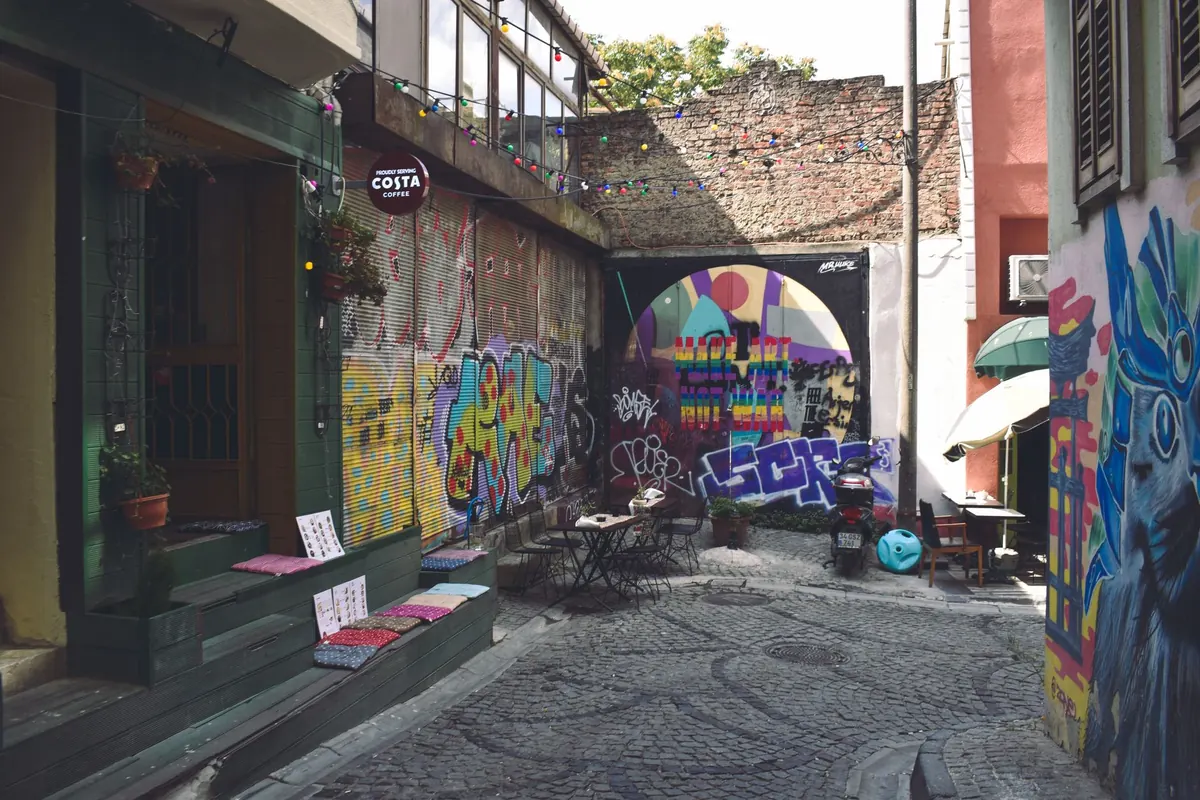
Graffiti is fundamentally about writing. A tag, a throw-up, a full piece — the subject is a name, and the craft is in how that name is drawn, styled and composed. Legibility is optional and often deliberately withheld. Street art is fundamentally about the image: a stencil of a figure, a portrait on a shutter, a paste-up of a face. It is usually designed to be understood by anyone walking past.
That's a useful starting point, not a law. There are figurative graffiti pieces, and there are street artists whose work is mostly words. Use it as a first glance, not a verdict.
Permission: who agreed to this?
A commissioned mural on the side of a school and a tag on a tram shelter are both paint on public surfaces, but one was negotiated and one wasn't. Permission is usually the clearest visible difference — and the one with the most practical consequences.
Still, permission doesn't tell you what a thing is. It tells you what you can do about it. There is unsanctioned street art, and there is graffiti painted with the owner's blessing on a legal wall or inside a yard. Plenty of writers have spent decades painting only where they were allowed.
Intent: who is it speaking to?
This is the test the writers themselves use. Graffiti is largely a conversation within a scene. A tag is a signature, a claim, a way of saying I was here to people who know how to read it, and the mesh of tags across a city is a running dialogue. Street art, at its core, addresses the passer-by: the commuter, the tourist, the person who has no idea who made it and doesn't need to.
That difference in audience shows up in the work. A piece that baffles a shopkeeper may be perfectly legible to another writer. A mural that a writer finds obvious and sentimental may be the thing that makes a child stop on the way to school.
Context: where is the paint?
The same spray can produces very different objects depending on the wall. A tag on a shutter in a peripheral quartiere is a different act from a tag on a sixteenth-century palazzo. Italy makes this sharp: the density of historic fabric, the rules protecting listed buildings and the simple fact that many surfaces here are centuries old all raise the stakes. It also means the local argument is less about style than about place.
Rules vary by city and by building, and they change. If a specific wall matters to you — because you own it, or you want to paint it — check with your comune and, for anything historic or listed, with the heritage authority before you buy paint. For a dispute over damage or a commission, a local lawyer is worth the call. This isn't a topic where general advice substitutes for the actual rules on your street.
Why the distinction matters in practice
Vocabulary shapes outcomes. Call a new mural "graffiti" in a council meeting and you're more likely to get it buffed than funded. Call a tag "street art" in a news story and you've handed the writer a legitimacy they may not have asked for. Neighbourhoods argue about this constantly, usually without agreeing on which word they're arguing about.
The labels carry money too. A commissioned mural can become part of a regeneration scheme, a festival, a tourism pitch. A tag becomes a maintenance line in a budget. The paint is cheap; the framing is where the value sits.
Six questions to ask in front of a wall
- Can I read it? If the answer is a name rendered in a style I can't parse, I'm probably looking at graffiti.
- Who signed it? A tag, a crew name or a handle tells you which world the maker moves in.
- Was it negotiated? Look for a clean edge, a freshly primed wall, scaffolding history, a plaque, a festival logo.
- Who's the audience? Is it meant for other writers, or for whoever happens to walk past?
- Where is it? A designated wall, a private shutter, a heritage facade — the surface tells you how the city feels about it.
- Is it recent? Fresh paint, no dust, no weathering. New work often means an ongoing conversation rather than a finished project.
What to do with this the next time you're out walking
Look first, label second. Notice whether the thing in front of you is writing or image, whether it was agreed to, and who it seems to be talking to. Most walls will answer two of those questions immediately and leave the third open, which is fine — ambiguity is part of the form.
Photograph it, note the street, and if you write about it, be precise with your words. Say graffiti when you mean writing, street art when you mean image, mural when you mean a large commissioned wall. If you own a wall and want it painted, talk to the comune or a local arts organisation about permissions before anything else. And if a wall near you changed overnight, don't rush to judgement. The paint is only half the story; the other half is who agreed to it, who it's for, and where it landed.
Photo: Abdullah Karataş / Pexels